A fruit fly trap, and why most of them let the flies back out
Every fruit fly trap has a way in, and every way in is also a way out. The one that works makes the exit hard to find: a funnel in, a dark middle, one small hole away from the light, and a liquid they sink in.
By The Pest GuyLast updated
The short answer
The best fruit fly trap is the one that's hardest to leave.
Fruit flies find a trap by smell. Cider vinegar works because acetic acid, the sharp smell in it, is the main thing they follow. In a wind tunnel study, vinegar odour drew 62% of hungry flies within 15 minutes. Getting them in is the easy half.
Keeping them is where most traps leak. An adult is about 3 to 5 mm long and gets through ordinary fly screen, so any hole a fly can get in through, it can get back out of. A trapped fly also heads for the light. So the design that works sends them down a funnel, drops them into a dark middle, keeps the one exit out of the light, and gives them cider vinegar with a drop of washing-up liquid in it, so the ones that land sink.
And a trap only ever catches adults. The eggs are in something soft and fermenting nearby, and until that goes, the trap is counting the new ones as they hatch. Finding it is the whole of tracking down fruit flies in the house, and it's quicker than it sounds.
Fruit fly traps compared on what keeps flies in
Six kinds of trap get made or sold for fruit flies, under names from fruit fly catcher to fruit fly killer. They all pull flies in somehow. Where they differ is what stops a fly leaving.
| Trap | What pulls them in | What keeps them in | Where it falls down |
|---|---|---|---|
| Paper cone in a jar of cider vinegar | The smell of the vinegar. Acetic acid is the main thing they follow | A funnel. Flies walk down it and drop into the jar | Any gap where the paper meets the glass is a second way out, so it has to be taped all round |
| Cling film with holes over a jar or bowl | The vinegar, through the holes | Small holes, and only that | Every hole is an exit, and the holes face the room light, which is where a trapped fly heads |
| Open bowl of vinegar with washing-up liquid | The vinegar | Nothing holds them. The soap lowers the surface tension, so a fly that lands sinks | Only catches the ones that land on the liquid. A fly that sniffs and leaves is free |
| Yellow sticky card | Colour, not smell | Glue | UC IPM lists fungus gnats, thrips, whiteflies and aphids as what yellow cards catch. Fruit flies are not on the list |
| Plug-in UV or LED light trap | Light rather than bait | A fan, a glue board or a grid | It works on light, while the cue that brought fruit flies to your kitchen is the smell of fermenting food |
| Outdoor "fruit fly trap" with liquid lure | A vinegar and fruit lure, made for spotted wing drosophila | A drowning liquid | Sold for outdoor use on soft fruit in gardens and allotments. A different fly, and a different job from the kitchen |
Sources: University of Kentucky ENTFACT-621; University of Wisconsin Extension; University of Rhode Island GreenShare (adapted from Ohio State University Extension); UC IPM; RHS; McGill Office for Science and Society; Becher et al. 2010, Journal of Chemical Ecology; Gorostiza, Colomb and Brembs (bioRxiv).
Watch the label on anything sold for outdoors. Some traps sold in the UK simply as a "fruit fly trap" are built for spotted wing drosophila, a fly the RHS says was first reported in Britain in 2012. Unlike our native vinegar flies, it attacks ripe, unblemished soft fruit, and the traps for it are made to hang among raspberries and strawberries in a garden or allotment. That's a different fly and a different job from an indoor trap by your fruit bowl.
Same with the yellow sticky card. It's a fine tool for the job it's listed for, and UC IPM's list of what those cards catch starts with fungus gnats. The RHS recommends them for fungus gnats near house plants, where the larvae live in damp compost. A card by a plant pot that fills with tiny flies is telling you about the compost, which is where fruit flies and fungus gnats part company.
Why fruit flies get back out of most traps
Two facts about the fly decide it: how small it is, and where it goes once it's trapped.
Size first. The usual advice for the cling-film trap is to make the holes big enough to get in and too small to get out. There's no such size. A fruit fly is about 3 to 5 mm long, and the University of Rhode Island notes they get through ordinary house fly screen. Any hole that lets one in will let it out.
Then light. Flies move towards light when they're startled, and newly emerged flies are drawn to it too. A fly that has just dropped into a jar is a startled fly. On a clear jar with cling film stretched over the top, the holes are on the bright side, facing the room. The fly heads for the light and arrives back at the way in.
Ohio State's extension service published a jar trap that uses the same habit the other way round. Black paint or paper goes over the top third of an upturned jar, with bait underneath and a sticky coat of diluted honey or vegetable oil inside. The flies leave the bait, fly up to the light part of the jar, and get stuck there.
The paper cone has a second leak, and it's the rim. Unless the cone is taped all the way round, any gap between paper and glass is another way out. The open bowl has no exit problem at all, because it has no walls. It catches only what lands on the liquid. If you'd rather build your own, the homemade fruit fly trap page goes through fixing each jar version.
What to look for in a fruit fly trap: four things that keep flies in
The best trap for fruit flies has all four. Most have one or two.
1. A funnel in
Flies follow the smell down the funnel and drop through the bottom. Kentucky and Wisconsin both build their jar trap around one, and Wisconsin's reason is the whole point: it's there to keep the adults trapped.
2. A dark middle
A trapped fly goes looking for light, so the inside of the trap should be the part it least wants to stay in, and the exit should be in the darkest bit of it.
3. One exit, away from the brightest point
Making the hole small doesn't stop them. Putting it where they aren't looking does. Better still if the brightest thing a trapped fly can see isn't a way out at all.
4. A liquid they sink in
A vinegar pool they cannot stand on. McGill's Office for Science and Society explains why the soap matters: it lowers the surface tension, making it harder for the flies to stay on the surface and avoid drowning.
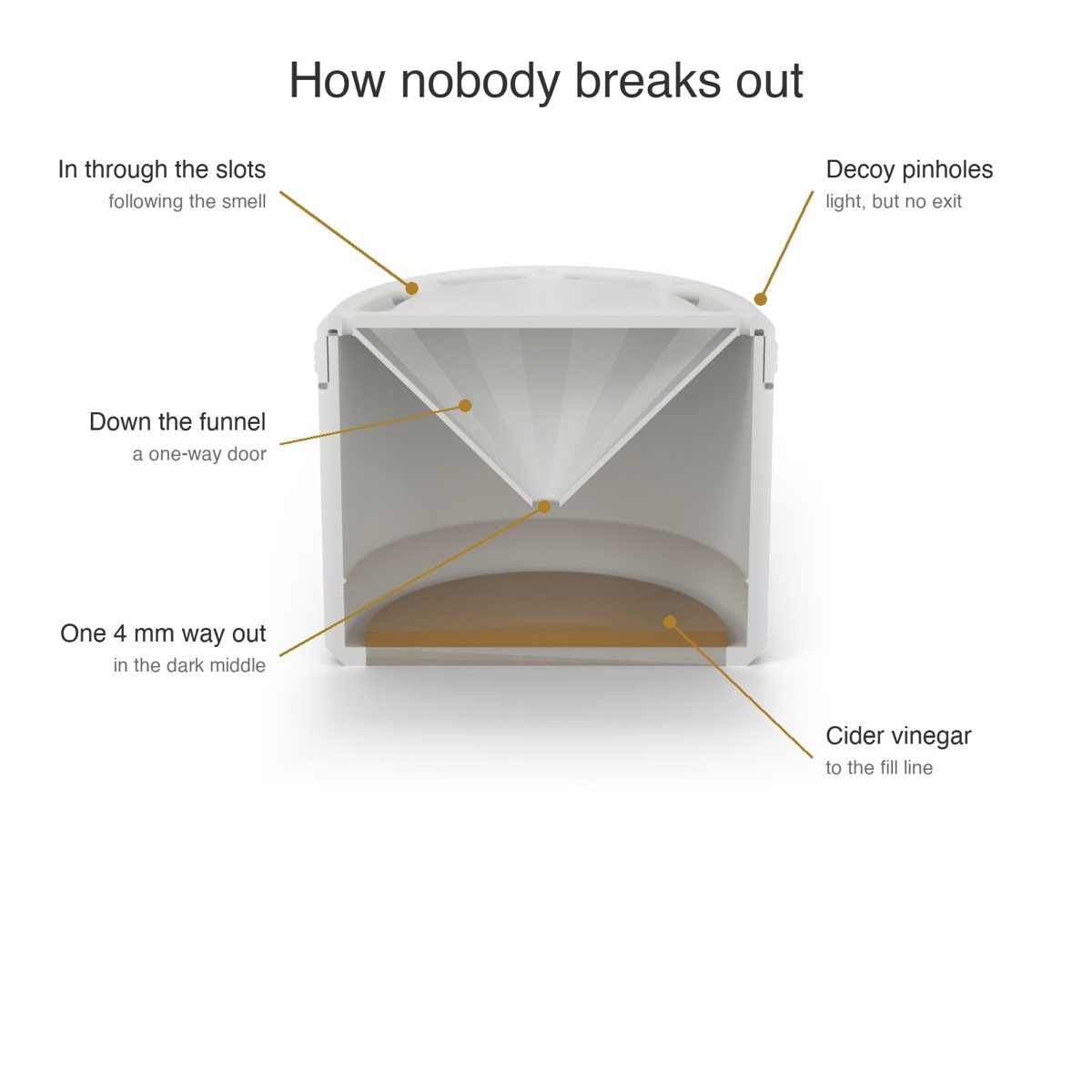
The trap in the card below is built on those four. Eight slots in the lid lead into a funnel, and the flies drop through a single 4 mm hole that hangs in the shadow of the lid's solid centre. The brightest points they can see from inside are eight pinholes at the edge of the lid, too small to squeeze through and well away from the real way out. Under it all is the vinegar pool, filled to a moulded line.
One trap built around all four
It's a reusable indoor trap, made for fruit flies drawn to cider vinegar. Stand it in the kitchen next to the fruit bowl or the food bin, and when it's full, tip it down the sink, rinse both parts and refill. There are no sticky papers or refill packs to buy.
What I’d use
Reusable cider vinegar trap
Escape-proof fruit fly trap
A two-part cup and lid you fill with about 25 ml of cider vinegar and stand by the fruit bowl.
Eight slots in the lid feed a funnel that drops flies through one 4 mm hole into the dark middle of the cup. The brightest points a trapped fly can see are pinholes too small to get through, set away from the real exit, so the way out is the place they are least likely to look.
- Ways in
- Eight slots in the lid, into one funnel
- Way out
- One 4 mm hole, under the solid centre of the lid
- Holds
- About 25 ml of vinegar, to the moulded fill line
- Size
- 6.7 cm across, 5.4 cm tall
- Refills
- None to buy. It runs on cider vinegar from the cupboard
Watch out for
- Vinegar and washing-up liquid not included.
- Made for fruit flies. Flies from a plant pot or drain need the source found.
- Tip, rinse by hand and refill once it fills up.
That link earns me nothing. It is not an affiliate link, no brand pays for a mention here, and I get the same whether you buy this or ignore it. It is on the page because it is what the job takes.
No brand pays for a mention here, and nothing on this page earns me a commission. The card above links out to a shop, and I get the same whether you buy or ignore it. The link is there because finding the thing is the boring half of acting on advice, which is also why the watch-outs sit on the same card as the reasons to buy.
Bait, and the drop of washing-up liquid
Cider vinegar is the standard for a reason, and the soap does a different job from the bait.
In the wind tunnel work, acetic acid on its own drew flies, and two other things in vinegar, 2-phenyl ethanol and acetoin, made it stronger. McGill notes all of them turn up in fermenting food. Cider vinegar is just a cheap bottle of them. The apple cider vinegar page compares it with the other vinegars in the cupboard.
Wine and beer work too. Wisconsin baits its jar trap with ripe bananas, pears or wine, and notes that an old wine bottle with residue in the bottom will catch adults on its own.
Ripe fruit is worth adding. In a small student experiment at Texas A&M, with one trap per bait set outdoors, cider vinegar had caught the most flies by day two and banana slices the most by day eight. It's one trap each, so treat it as a hint rather than a result, but it points the same way as the trap's own setup: a small piece of very ripe banana or peach in with the vinegar.
The washing-up liquid isn't bait. Without it, flies can stand on the vinegar and walk off again. One drop breaks the surface tension and they go under.
A trap catches adults, so run it for a full life cycle
The numbers a fruit fly trap is up against, and what they mean for how long you leave it out.
| Measure | Figure | Source |
|---|---|---|
| Adult fruit fly length | About 3 to 5 mm, and small enough to get through ordinary fly screen | University of Rhode Island (adapted from Ohio State) |
| What a fly does when it is startled | Moves towards light. Newly emerged flies are also drawn to light | Gorostiza, Colomb and Brembs; University of Rhode Island |
| Starved flies drawn to vinegar odour in a wind tunnel | 62% within 15 minutes. Acetic acid was the main attractant | Becher et al. 2010, Journal of Chemical Ecology |
| Eggs per female | About 500, up to 2,000, laid singly on moist fermenting food | University of Rhode Island; University of Kentucky |
| Egg to larva | 24 to 30 hours. Larvae then feed for five to six days | University of Rhode Island |
| Egg to adult | About a week to 15 days, faster when warm | University of Kentucky; University of Wisconsin; University of Rhode Island |
The University of Kentucky puts the limit of any trap or spray in one line: unless the breeding sites are removed or cleaned, the problem will continue no matter how often insecticides are applied to the adults. That applies to fruit fly spray just as much as to a trap.
Read the table as a timetable. A female lays about 500 eggs on something moist and fermenting, they hatch in a day or so, and the larvae feed for five to six days. So a trap set today is still catching flies that were eggs on a banana skin last week. Clear the source, then keep the trap going for one full cycle, about two weeks, and how long fruit flies live stops being your problem.
If the flies keep coming and the fruit bowl is clean, check the plughole. Rhode Island's trick is to tape clear plastic over a drain or waste disposal overnight: if flies are breeding in there, they'll be in the bag by morning. Source first, trap second is the order on getting rid of fruit flies. And if they're bigger, darker flies arriving in numbers, that's a different hunt, covered in flies in the house.
About this resource
The fly facts on this page come from university extension sheets (Kentucky, Wisconsin, Rhode Island's, adapted from Ohio State, and UC IPM), the RHS on spotted wing drosophila, McGill's Office for Science and Society, and two research papers on fruit fly behaviour: Becher and colleagues on vinegar odour in the Journal of Chemical Ecology, and Gorostiza, Colomb and Brembs on flies moving towards light.
The honest limit is numbers. There is no catch figure here for any trap, because none I could stand behind exists. The product details come from the trap's own listing, and I haven't tested it or any other trap against each other.
Common questions
Why is my apple cider vinegar fruit fly trap not working?
Usually it is catching flies and losing them again. Check three things. If it is cling film with holes, every hole is an exit and they face the light a trapped fly heads for. If it is a paper cone, any gap at the rim is a second way out. And without a drop of washing-up liquid, flies can stand on the vinegar instead of sinking. If the small flies hang around a plant pot rather than the fruit bowl, they may be fungus gnats, which the RHS links to damp compost in house plants.
What kills the most fruit flies?
No trap type has a published catch figure I would trust, so nobody can honestly rank them by numbers. What decides it is design, and the source. The University of Kentucky is blunt that unless the breeding sites are removed or cleaned, the problem will continue no matter how often insecticides are applied to the adults. A trap that keeps what it catches, next to a fruit bowl with nothing rotting in it, is the combination that ends it.
What can I use instead of apple cider vinegar to trap fruit flies?
Wine or beer both work as bait, and the University of Wisconsin baits its jar trap with ripe bananas, pears or wine. Old wine bottles with residue in them catch flies on their own. Whatever you use, add one drop of washing-up liquid if it is a liquid, so the flies sink instead of standing on it.
How do you get rid of fruit flies in 2 minutes?
You do not, and anything promising it is selling the flying ones as the whole problem. The next generation is already sitting in the fruit as eggs and larvae, where no trap reaches. A trap clears the adults over days. Binning the source is what stops the next batch.
How long does a fruit fly infestation last?
As long as something is breeding them, plus one life cycle. Egg to adult takes about a week to 15 days depending on how warm it is, so once the source has gone, adults keep emerging for up to two weeks. Keep a trap running through that and the numbers fall away.