Apple cider vinegar for fruit flies: why it works, and why the washing-up liquid matters
Cider vinegar works because it smells of fermentation, which is what fruit flies are really hunting. The washing-up liquid is there because a fruit fly is light enough to stand on the vinegar without it. Know both and you can pick the right bottle and fix a trap that has stopped catching.
By The Pest GuyLast updated
The short answer
Yes, it works, and the reasons tell you how to make it work better.
Fruit flies are after the yeast growing on fruit, more than the fruit itself. Research published in 2012 found yeast on its own was enough to draw fruit flies in, get eggs laid and raise the larvae, with the smell of the fruit only secondary. Cider vinegar is apple juice that has been fermented twice, first to alcohol and then to vinegar. It smells like the best rotting fruit in the house, and that is why they go for it. It is also why vinegar makes a hopeless fruit fly repellent.
The washing-up liquid has one job. Vinegar is mostly water, and water has enough surface tension to hold up a small, light insect. A fruit fly is 3 to 5 mm long. Without the drop of soap it can land on the vinegar, drink and fly off. With it, the surface gives way and the fly goes under.
Two things follow. Pick a vinegar that was brewed from something, because acid on its own is a poor lure. And remember the trap only ever catches adults. The eggs are in whatever they are breeding in, which is why getting rid of fruit flies starts with finding the source.
Which vinegar to use, by how each one is made
What decides it is what is left in the bottle from the fermentation, not how sour the vinegar is.
| Vinegar | Made from | What is left in it | For a fruit fly trap |
|---|---|---|---|
| Cider vinegar | Apple juice, fermented to alcohol, then to vinegar | Everything the apple and the yeast left behind | The one to use |
| Red or white wine vinegar | Grape juice, fermented to alcohol, then to vinegar | Everything the grape and the yeast left behind | As good a bet as cider |
| Malt vinegar (the chip-shop bottle) | A brew of malted barley, fermented without distilling | The yeast side of it, with no fruit | Worth a go if it is all you have |
| White, spirit or distilled vinegar | Alcohol that was distilled first, then turned to vinegar | Mostly acid and water | The weakest of the four |
Source: US FDA vinegar definitions (CPG Sec. 525.825), read against the research above. The ranking follows from how each vinegar is made. It is not a kitchen trial of one bottle against another.
The US Food and Drug Administration's definitions show the difference plainly. Cider, wine and malt vinegar are each made by two fermentations of the juice or the brew itself, first to alcohol and then to vinegar. Malt vinegar is made "without distillation". White, spirit or distilled vinegar is made from "dilute distilled alcohol". The distilling happens before it ever becomes vinegar, so whatever the yeast and the fruit or grain left behind is gone by then.
That matters because of the research in the next section: fruit flies follow a blend of fermentation smells, and acid on its own does badly. Malt vinegar is the interesting one for a UK kitchen. There is no fruit in it, but it keeps the yeast side of the smell, and yeast is the part that counts. If you are making a trap from a jar instead of a ready-made one, the homemade fruit fly trap page covers what to do without cider vinegar in the cupboard.
What the research says a fruit fly is actually following
Five studies, and they all point the same way. The smell of fermentation is a blend, and the blend beats any single part of it.
| What they found | Study | What it means for your trap |
|---|---|---|
| Yeast on its own was enough to draw fruit flies, get eggs laid and raise larvae. Fruit smell came second. | Becher et al., Functional Ecology, 2012 | The flies are following fermentation. The vinegar is a stand-in for something rotting. |
| A blend of ethanol, acetic acid and 2-phenylethanol drew six times more flies than any one of them alone. | Zhu, Park and Baker, Journal of Chemical Ecology, 2003 | Acid on its own is a weak lure. The mix is what works. |
| The best real vinegar culture caught 19 to 37% of about 1,500 released flies. An acid solution made to copy it caught 0.9 to 4.6%. | Ishii et al., Applied and Environmental Microbiology, 2015 | What a vinegar was made from matters more than how sour it is. |
| Flies walked towards a faint cider vinegar smell. At a much stronger concentration it lost most of its pull. | Semmelhack and Wang, Nature, 2009 | A bigger bowl or a sharper smell is not a stronger lure. |
| Cider vinegar mixed with red wine beat plain acetic acid mixed with ethanol (spotted wing drosophila, a related species). | Landolt, Adams and Rogg, Journal of Applied Entomology, 2012 | The same pattern again, in a close relative: the real thing beats the chemistry set. |
Sources: Becher et al. 2012; Zhu, Park and Baker 2003; Ishii et al. 2015; Semmelhack and Wang 2009; Landolt, Adams and Rogg 2012. The 2012 Landolt study is on spotted wing drosophila, a close relative of the common fruit fly.
The clearest of them is the 2015 study. Researchers released about 1,500 fruit flies into a cage and trapped them with vinegar. Their best real vinegar culture caught between 19 and 37% of the flies. Then they made an acid solution with the same measured amounts of acetic acid and two other compounds in it, to copy that vinegar. It caught between 0.9 and 4.6%. Same sourness, a fraction of the catch. The difference was everything else the fermentation had made.
The 2009 study in Nature adds a twist. Flies walked towards a faint cider vinegar smell, and when the researchers made it much stronger, most of the pull went. A stronger dose switched on an extra smell channel in the fly's brain that works against the attraction. Separate research found fruit flies have smell neurons that respond to acids, and switching those on makes them back away. So a sharper smell is not a better lure, and there is nothing to gain from a big open bowl of the stuff.
Ohio State University's extension fact sheet on these flies says the same thing in plain words: adults are attracted to yeast growth that causes fermentation, and the larvae feed mainly on the yeast. That is also why a small piece of very ripe fruit in the vinegar can help. It is another fermenting thing for them to find.
Why the washing-up liquid matters
It is the difference between a feeding station and a trap. One drop does it.
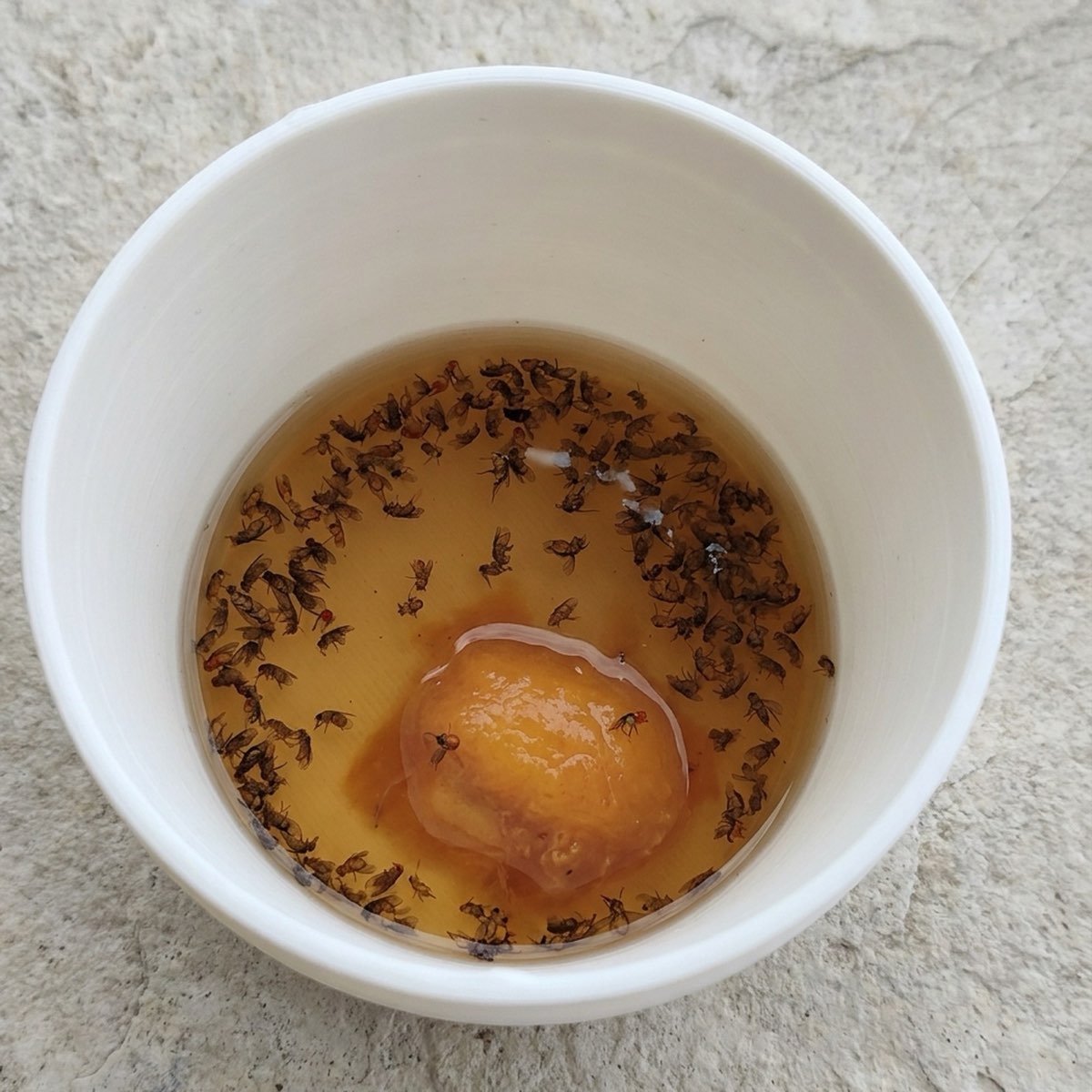
Water at 20C has a surface tension of 72.8 dynes per centimetre. That is the pull between water molecules at the surface, and it is strong enough that a small insect's weight cannot break through it. It is how a pond skater walks on a pond. Cider vinegar is mostly water, and a fruit fly is 3 to 5 mm long, so it can land on the vinegar, stand there, drink and leave.
Soaps and detergents lower surface tension. That is what they are for: it is how they get water into the fibres of your clothes. Add a drop to the vinegar and the surface stops holding the fly up. It goes under and it does not come back.
So the soap does not make the flies stick, and it does nothing to their wings. It takes away the floor they were standing on. That also tells you how much to use: only enough to lower the surface tension. Oregon State University's traps for a close relative of the fruit fly use cider vinegar "plus a drop of liquid soap". A drop. Stir it in gently so you are not whipping up a foam on top.
Why your vinegar trap has stopped catching
Each of these has a reason behind it, so each has a fix.
Something nearby smells better. A bowl of overripe bananas, the food caddy, a sticky recycling bin or a forgotten onion is real fermentation, and the trap is an imitation of it. Ohio State lists rotten bananas, potatoes, onions, melons and dirty bins among the things that can breed a heavy population on their own. Clear those, and the vinegar becomes the best smell they can find. Where to look is on the fruit flies in the house page.
The vinegar has gone flat. Researchers trapping a close relative of the fruit fly in fruit fields empty their traps and replace the cider vinegar weekly. Treat a week as the limit, and sooner if it is full of flies.
There is no soap in it. Without the drop of washing-up liquid, you are feeding them.
They can get out again. An open bowl catches only the flies that land on the surface. Cling film with fork holes lets flies walk back out the way they came in. What makes a trap hold on to the flies it catches, the funnel, the dark inside and the one small exit, is on the fruit fly trap page.
They are not fruit flies. Fungus gnats from houseplant compost are often mistaken for fruit flies, and Wisconsin's extension service is blunt that vinegar traps do not work on them. Drain flies breed in the sludge left as water evaporates in a pipe, which no vinegar can reach. Fruit flies vs fungus gnats sets the two side by side.
What the vinegar cannot do
It catches adults. Most of the problem is not adults yet.
Ohio State Extension's figures show why. A female lays about 500 eggs, and up to 2,000, one at a time near the surface of something moist and fermenting. They hatch in 24 to 30 hours. The larvae feed for five to six days, and the whole cycle from egg to adult takes 8 to 15 days depending on the temperature. New flies can mate within about two days.
So a trap left out for a weekend is catching the flies that hatched before you set it, while the next lot are still in the fruit. Bin the source, then keep the trap going long enough to catch what was already on its way. How long that is depends on how warm your kitchen is, and how long fruit flies live works it through. If you never found anything rotting, the eggs may well have come home on the shopping: Ohio State notes that produce brought indoors carries the flies in with it, at every life stage. That is the subject of where fruit flies come from.
And if it is not tiny flies at all but a sudden mass of bigger ones, that is a different animal breeding in something different, and flies in the house is the page for it.
Cider vinegar, a drop of soap, and nowhere to go
Everything on this page, built into a cup. About 25 ml of cider vinegar with a drop of washing-up liquid sits under a funnel that drops flies through one 4 mm hole into the dark middle of the cup. Newly emerged fruit flies head for light, and the brightest points a trapped fly can see are pinholes too small to get through, well away from the real way out. It is made for fruit flies. If they are coming out of a plant pot or a drain, find that first.
What I’d use
Reusable cider vinegar trap
Escape-proof fruit fly trap
A two-part cup and lid you fill with about 25 ml of cider vinegar and stand by the fruit bowl.
Eight slots in the lid feed a funnel that drops flies through one 4 mm hole into the dark middle of the cup. The brightest points a trapped fly can see are pinholes too small to get through, set away from the real exit, so the way out is the place they are least likely to look.
- Ways in
- Eight slots in the lid, into one funnel
- Way out
- One 4 mm hole, under the solid centre of the lid
- Holds
- About 25 ml of vinegar, to the moulded fill line
- Size
- 6.7 cm across, 5.4 cm tall
- Refills
- None to buy. It runs on cider vinegar from the cupboard
Watch out for
- Vinegar and washing-up liquid not included.
- Made for fruit flies. Flies from a plant pot or drain need the source found.
- Tip, rinse by hand and refill once it fills up.
That link earns me nothing. It is not an affiliate link, no brand pays for a mention here, and I get the same whether you buy this or ignore it. It is on the page because it is what the job takes.
No brand pays for a mention here, and nothing on this page earns me a commission. The card above links out to a shop, and I get the same whether you buy or ignore it. The link is there because finding the thing is the boring half of acting on advice, which is also why the watch-outs sit on the same card as the reasons to buy.
About this resource
The weight on this page is carried by published research and public bodies: studies in Nature, Functional Ecology, the Journal of Chemical Ecology, Applied and Environmental Microbiology and the Journal of Applied Entomology; Ohio State University Extension's fact sheet on vinegar flies; Oregon State University's fruit fly trapping guidance; the US Food and Drug Administration's vinegar definitions; and Georgia State University's HyperPhysics notes on surface tension.
The honest limit is the vinegar ranking. It follows from how each vinegar is made and what the research says flies follow, and it is not a kitchen trial of one bottle against another. The lab studies measure smell in controlled conditions, so they tell you which way to lean, not how many flies your trap will catch by Friday.
Common questions
Can I use normal vinegar instead of apple cider vinegar?
In the UK the normal bottle is malt vinegar, and it is worth a go. It is brewed from malted barley and fermented without distilling, so it keeps the yeast side of the smell, though there is no fruit in it. White, spirit or distilled vinegar is the weakest choice. It is made from alcohol that was distilled first, so it is mostly acid and water, and acid on its own is a poor lure. Cider or wine vinegar is the one to buy.
Why isn't my apple cider vinegar trap working?
Usually one of four things. Something nearby smells better, like a ripe fruit bowl or the food bin. The vinegar has been out a week or more and gone flat. There is no washing-up liquid in it, so flies land, drink and leave. Or they are not fruit flies at all: fungus gnats from a plant pot are often mistaken for them, and vinegar traps do not work on fungus gnats.
How long does it take for fruit flies to be attracted to apple cider vinegar?
There is no honest number for that, because it depends on what the trap is competing with. A trap next to a bowl of overripe bananas is the second-best smell in the room. Clear the fruit away and the vinegar becomes the strongest fermentation smell they can find. Researchers trapping a close relative of the fruit fly change their cider vinegar weekly, so a week is a fair point to tip it and refill.
What attracts fruit flies the most?
Fermentation. Research on fruit flies found yeast alone was enough to draw them, lay eggs and raise larvae, with the smell of the fruit itself only secondary. Ohio State Extension lists overripe fruit and vegetables, baked goods containing yeast, bins, juice, cider, beer, wine and vinegar. Anything that is fermenting is on the list.
Will one fruit fly multiply?
A mated female can. Ohio State Extension puts it at about 500 eggs per female, laid one at a time on something moist and fermenting, and up to 2,000. The eggs hatch in 24 to 30 hours and the whole cycle takes 8 to 15 days depending on temperature. That is why the source matters more than the trap.
Why are fruit flies so hard to get rid of?
Because the ones you can see are the smallest part of it. The eggs and larvae are in whatever they are breeding in, and a vinegar trap only ever catches adults. Ohio State is plain that sanitation is critical: sometimes getting rid of one overripe banana, an old juice carton or a dirty bin is the whole fix.
What smell do fruit flies hate the most?
The research points somewhere unexpected: too much of the smell they like. In a lab, flies were drawn to a faint cider vinegar smell and lost most of their interest when it was much stronger, and fruit flies have smell neurons for acids that make them back away when switched on. So a sharper trap is not a better one. Whether any scent keeps them out of a kitchen is a separate question, and the repellent page covers it.