How to get rid of fruit flies, start to finish
Bin whatever they're breeding in, then trap the adults that are left, and keep the trap going until a full hatch has passed without any more turning up. The flies in the air are the smallest part of it. Most of them are still eggs and larvae.
By The Pest GuyLast updated
The short answer
To stop fruit flies, it's two jobs, in this order. Get the order wrong and you'll be doing the second one for weeks.
First, take away what they're breeding in. A female fruit fly lays about 500 eggs in her life, up to 2,000, one at a time on the surface of something moist and fermenting. The eggs hatch in 24 to 30 hours and the larvae feed there for five or six days. So the overripe banana is a nursery, and binning it does more than any spray.
Then catch the adults that are left. A cider vinegar trap stood where they gather picks off the ones already flying, and keeps picking off each new lot as it hatches. That last part is why it stays out for a while after the source has gone.
If the tiny flies are rising out of a plant pot, they're probably not fruit flies at all. That's fungus gnats, which breed in the compost, and nothing in a fruit bowl will touch them.
Every fix, and which stage of the fly it reaches
A fruit fly spends most of its life as an egg, a larva or a pupa, out of sight. This is what each fix actually reaches.
| What you do | What it reaches | What it leaves behind | Source |
|---|---|---|---|
| Bin, eat or fridge anything soft, overripe or fermenting | The eggs and larvae in it. Eggs are laid near the surface of moist, fermenting food and the larvae feed there for five to six days | Any larvae that have already crawled out to pupate somewhere drier | Ohio State University Extension; University of Kentucky |
| Clear the hidden sources: a forgotten potato or onion, juice spilled under the fridge, unrinsed bottles and cans, the recycling bin, wet mops and cloths | Breeding sites a fruit bowl check misses. Kentucky says one rotting potato or one juice spill can breed thousands | Nothing, if you find them all. Miss one and the problem continues | University of Kentucky; University of New Hampshire |
| Scrub the slime out of a plughole or drain they keep rising from | Larvae living in the gelatinous film inside the pipe | Nothing, if that was the source. Tape a clear food bag over it overnight first to find out | Ohio State University Extension; University of Kentucky |
| A cider vinegar trap | Adults that are already flying, including each new batch as it emerges | Eggs and larvae. New Hampshire rates trapping well below kitchen sanitation for that reason | University of New Hampshire; University of Kentucky |
| An aerosol fly spray | The adults it hits | Every larva. Ohio State says it does nothing to the immature stages, so the spraying has to be repeated as each new lot emerges | Ohio State University Extension |
| Keep ripe fruit and veg in the fridge from now on | The next infestation, by stopping fermentation before it starts | Anything already breeding elsewhere in the kitchen | Ohio State University Extension; University of Kentucky |
Sources: Ohio State University Extension, "Vinegar Flies" (HYG-2109-97); University of New Hampshire Cooperative Extension, "Fruit Flies"; University of Kentucky Entomology, ENTFACT-621 "Fruit Flies". Read across the rows and the pattern is plain: the two things you can buy reach adults only, and the things that cost nothing reach everything else.
Step one: find what they're breeding in
The fruit bowl is the obvious place. It's often not the only one.
Fruit flies find food by smell, and what they're after is fermentation. Most kinds don't breed in sound fruit at all. They go for anything damaged, overripe or starting to rot. So go through the fruit bowl and the veg rack first, and bin anything soft, split or leaking. Kentucky's extension service puts it simply: ripe produce should be eaten, thrown away or put in the fridge.
Then look further. The University of Kentucky says a single rotting potato or onion forgotten at the back of a cupboard, or a juice spill under the fridge, can breed thousands. So can a recycling bin that never gets rinsed. New Hampshire's list adds the apple cores in a child's bedroom bin, and Ohio State's adds a sour mop or dishcloth and an empty ketchup bottle. Rinse bottles, cans and cartons before they go in the recycling, and get food scraps out to the compost or the caddy outside rather than letting them sit in the kitchen.
Drains are the one place you can't see into. If the flies keep coming up from a plughole, do what two university extension services recommend and tape a clear plastic food bag over it overnight. If they're breeding in the slime inside the pipe, the adults come up into the bag by morning, and the gelatinous film in the pipe is what needs scrubbing out. If the bag is empty, the drain probably isn't the source.
The full room-by-room search, including the bedroom and the space under the fridge, is in finding the fruit flies' source in your house. And if you're wondering how they got in when every window was shut, the short version is that the eggs often come home on the fruit.
Why the overnight fixes never finish it
Speed is the wrong thing to chase. The clock belongs to the eggs.
Every "get rid of fruit flies overnight" trick deals with the adults, and the adults are the stage that's about to be replaced. Eggs laid today hatch tomorrow. New adults are ready to mate in about two days, and they mate more than once. Ohio State puts the whole cycle at 8 to 15 days depending on temperature.
Temperature matters more than people expect. Laboratory figures from the Bloomington Drosophila Stock Center put one generation, egg to adult, at about 9 days at 25°C and 19 days at 18°C. A cooler room slows them down, which sounds like good news until you realise it also means the last larvae in a missed source take longer to come out. It is also why a heated kitchen keeps them going whatever the season.
So here's the rule I'd work to. Once the source is gone, leave the trap out until it has stayed empty for longer than one full cycle at the temperature of your kitchen. New flies in it after a week means something is still breeding, and the answer is to go back to step one rather than to add another trap. More on the timings, and on how long the adults live, is in how long fruit flies live.
Step two: a trap for the ones already flying
Once the source is gone, this catches the adults that are left and each batch that hatches after. Fill it with about 25 ml of cider vinegar and a drop of washing-up liquid, and stand it next to the fruit bowl or the food bin. It's made for fruit flies. If yours are rising from a plant pot or a drain, find that source first, because no trap reaches the larvae.
What I’d use
Reusable cider vinegar trap
Escape-proof fruit fly trap
A two-part cup and lid you fill with about 25 ml of cider vinegar and stand by the fruit bowl.
Eight slots in the lid feed a funnel that drops flies through one 4 mm hole into the dark middle of the cup. The brightest points a trapped fly can see are pinholes too small to get through, set away from the real exit, so the way out is the place they are least likely to look.
- Ways in
- Eight slots in the lid, into one funnel
- Way out
- One 4 mm hole, under the solid centre of the lid
- Holds
- About 25 ml of vinegar, to the moulded fill line
- Size
- 6.7 cm across, 5.4 cm tall
- Refills
- None to buy. It runs on cider vinegar from the cupboard
Watch out for
- Vinegar and washing-up liquid not included.
- Made for fruit flies. Flies from a plant pot or drain need the source found.
- Tip, rinse by hand and refill once it fills up.
That link earns me nothing. It is not an affiliate link, no brand pays for a mention here, and I get the same whether you buy this or ignore it. It is on the page because it is what the job takes.
No brand pays for a mention here, and nothing on this page earns me a commission. The card above links out to a shop, and I get the same whether you buy or ignore it. The link is there because finding the thing is the boring half of acting on advice, which is also why the watch-outs sit on the same card as the reasons to buy.
Traps, sprays and smells, briefly
What each one is for, so you buy the right thing or nothing at all.
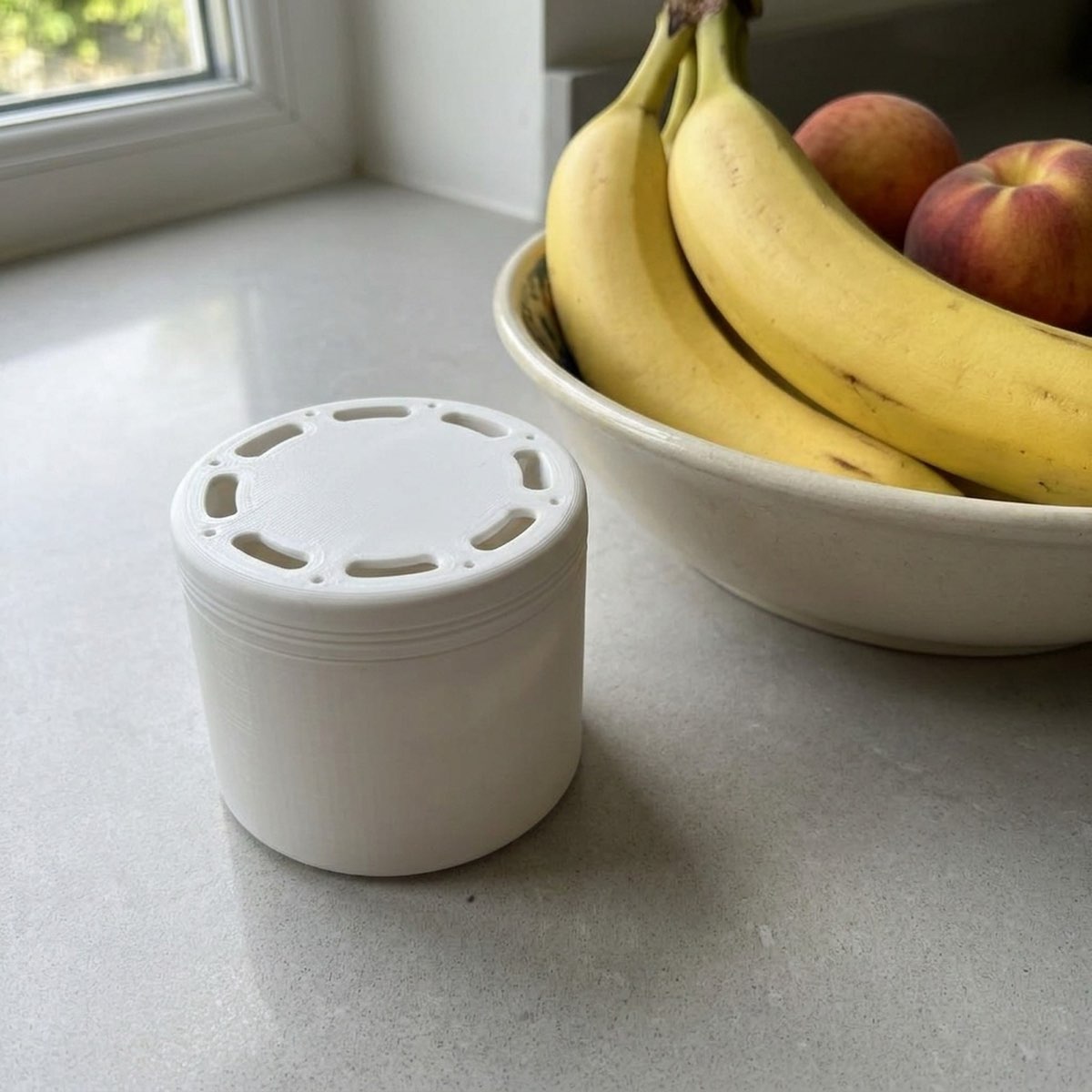
A trap works because the flies follow the smell of fermentation into it. The setup that matters is in why cider vinegar and a drop of washing-up liquid work. The washing-up liquid breaks the surface of the vinegar, so the flies sink instead of standing on it. If you'd rather make one, the jar and cling film version is covered in homemade fruit fly traps, and why they leak. What separates a trap that holds its catch from one that lets them walk back out is in what makes a fruit fly trap work.
A spray kills the adults it hits. Ohio State's extension service is blunt that it does nothing to the larvae, so you end up spraying again for every new lot that emerges until the source is found. New Hampshire's goes further and doesn't recommend chemical control for fruit flies at all, because they breed too fast for it to keep up. If you do use one in a kitchen, read the label and follow it. The detail is in does fly spray kill fruit flies.
A smell to keep them away is the one people ask about most, and it runs into the same wall. If they're breeding inside the house, there's nothing to keep out. That's covered in what scent keeps fruit flies away.
Getting rid of fruit flies naturally isn't a separate method, then. Binning the source, cleaning the drain and a vinegar trap are all natural already, and together they're the whole job.
If it doesn't stop, check it's fruit flies
The same small flies in the kitchen can be three different things, and only one of them lives in the fruit bowl.
A fruit fly is 2 to 3 mm long with a tan front, a black rear and, usually, red eyes. If that's not what you're seeing, the fruit fly identification guide puts it side by side with the other tiny flies. Flies hanging round the plant pots are usually fungus gnats rather than fruit flies, and flies that only ever appear around the sink or the shower can be drain flies, a different fly with a different fix, covered in tiny flies in the house and where they come from.
Ohio State notes they don't bite, and New Hampshire that they can carry bacteria onto food. Whether fruit flies are harmful covers what to do with food they've landed on.
About this resource
The weight on this page is carried by university extension services rather than by pest control marketing: Ohio State University's "Vinegar Flies" fact sheet, the University of New Hampshire's "Fruit Flies", and the University of Kentucky's ENTFACT-621, plus the Bloomington Drosophila Stock Center for the generation times. The trap's details come from its own listing.
The honest limit is identification. I can tell you what fruit flies breed in and what reaches each stage of them. I can't tell you which tiny fly is in your kitchen from a description, so if the steps above don't work, the first thing to question is whether they're fruit flies at all.
Common questions
What gets rid of fruit flies fast?
Binning the source, today. Whatever is soft, overripe or fermenting goes in the outside bin, and the fruit you want to keep goes in the fridge. That removes the eggs and larvae, which is most of the population. A cider vinegar trap next to where the fruit was then catches the adults that are left. Nothing faster finishes the job, because the trap and the spray only ever reach the flies in the air.
How do I get rid of fruit flies in 2 minutes?
You can't, and anything that promises it is only dealing with the adults in front of you. Fruit fly eggs hatch in 24 to 30 hours, so if the source is still there, a new lot is already on its way. Two minutes is long enough to bin the fruit bowl's worst offender, which is the most useful two minutes you can spend.
Why am I suddenly infested with fruit flies?
Because a batch hatched. Kentucky's extension service says infestations can start from fruit or veg that was already infested when it was brought home, and a female lays about 500 eggs over her life, one at a time. The life cycle can run in about a week, so one missed banana turns into a room full quickly.
Is my house dirty if I have fruit flies?
No. The eggs often come home on the fruit itself, so a spotless kitchen with a fruit bowl can get them. What keeps them going is a source, and the usual ones are easy to miss even in a clean house: a forgotten potato, a juice spill under the fridge, an unrinsed bottle in the recycling.
How do I find the source of a fruit fly infestation?
Start at the fruit bowl, then the bins and recycling, then the cupboards where potatoes and onions live, then under the fridge. A plughole you can test overnight with a bag over it, and the page on fruit flies in the house walks through every spot room by room.
What kills the most fruit flies in the house?
Removing the source, by a long way. It's the best thing for fruit flies indoors because it takes out the eggs and larvae as well as the next generation. For killing fruit flies in the kitchen once they're flying, a trap keeps working as each new batch hatches, where a spray only kills the flies it hits on the day. New Hampshire's extension service puts trapping well below kitchen sanitation, which is why the trap comes second.
Should you throw away fruit with fruit flies on it?
If it's soft, split or fermenting, yes, because that's where the eggs go. Fruit that's sound can be eaten or put in the fridge. Kentucky's advice for anything ripe is to eat it, bin it or refrigerate it.
Do fruit flies ever go away on their own?
Outdoors they die back when cold weather arrives. Indoors, a warm kitchen with a source in it keeps them breeding, so they last as long as the source does. Take the source away and the adults that are left die off or end up in a trap.